
THE FRONTLINE ADVANTAGE How Frontline Employees Accelerate Innovation — and What Managers Must Do About It?

The Frontline Advantage
How Frontline Employees Accelerate Innovation — and What Managers Must Do About It?
It may be that advancing governance frameworks, sprint methodologies, and digital transformation programs play the most visible role in shaping public sector progress in the years ahead.
But what will matter at least as much — perhaps more — is something far less visible: the quality of managerial judgment about where innovation actually comes from.
How individual managers see, activate, and protect the knowledge that frontline employees carry with them every day will become the decisive differentiator between public entities that genuinely improve citizen services and those that produce impressive frameworks that change very little.
In our analysis of Qatar's Civil Service and Government Development Bureau Innovation Playbook, a revealing structural tension emerges.
The Proximity Advantage
Great operational leaders, as Ritter and Ruggero observe in their McKinsey analysis, have an incisive sense of what matters — a disciplined orientation toward value that cascades powerfully to the frontline.
One of the authors recalls standing in a major automotive stamping line, listening to three hourly team members energetically describe how they cracked a millimeter-level defect in a car-body panel.
The story captures something essential: real operational knowledge does not accumulate in boardrooms. It accumulates on floors, at counters, and during citizen-facing work.
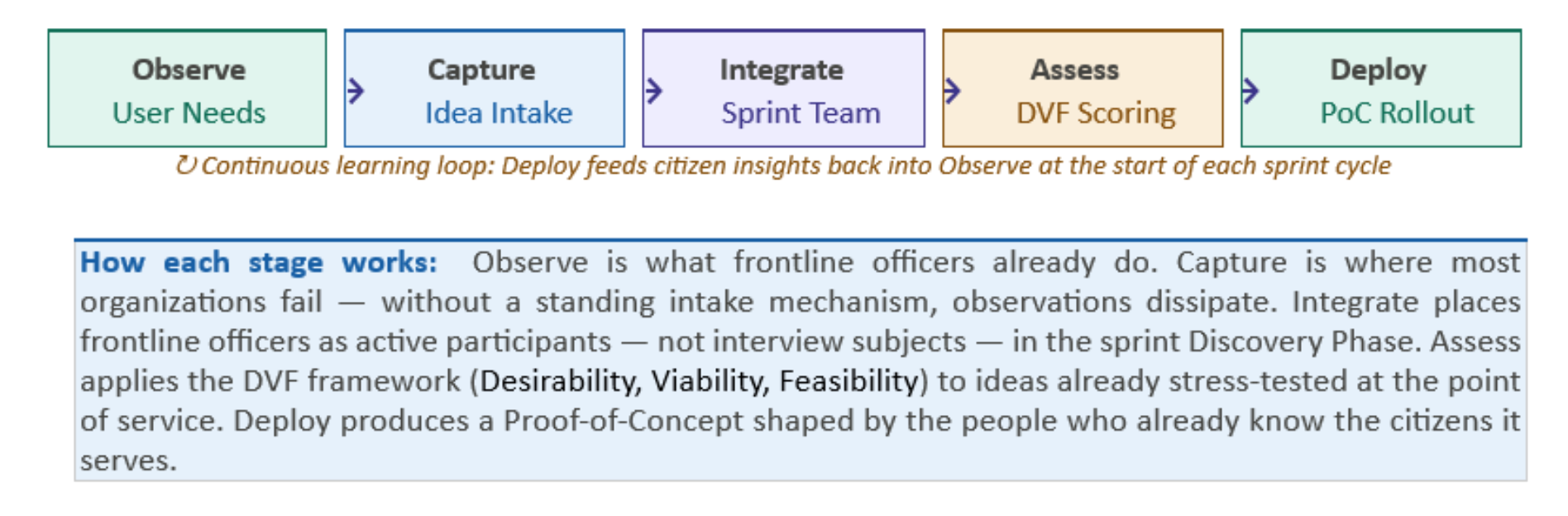
Five-stage Frontline Innovation Flow
- Observe: User needs.
- Capture: Idea intake.
- Integrate: Sprint team participation.
- Assess: DVF scoring.
- Deploy: Proof-of-Concept rollout.
Continuous learning loops feed citizen insights back into the observation stage at the start of every sprint cycle.
The Trust Dividend
Programs that sustain innovation over time almost always have one distinguishing feature: leaders who have built deep wells of trust with the people closest to the work.

Ritter and Ruggero describe this as the “trust dividend” — the organizational resilience that allows teams to stay the course after the exciting beginning gives way to long-term sustainment.
Frontline employees will only contribute their best observations when they are confident those observations will not be used against them.
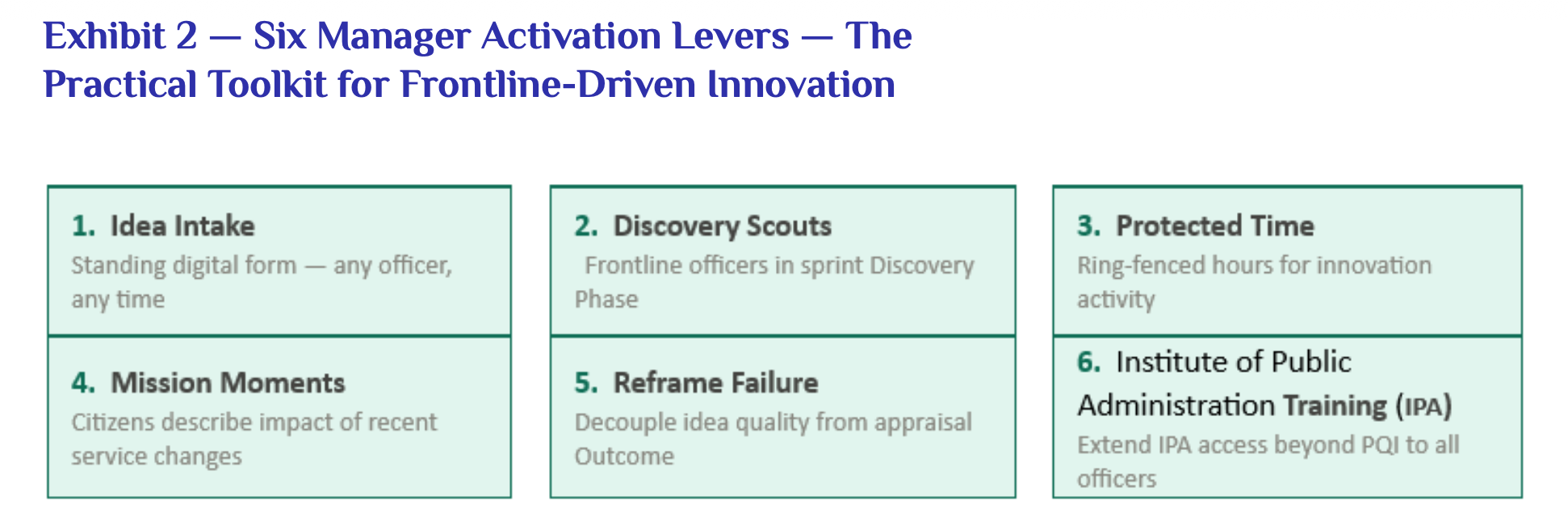
Six Manager Activation Levers
- Idea Intake: Standing digital form available anytime.
- Discovery Scouts: Frontline officers participate in sprint discovery.
- Protected Time: Ring-fenced hours for innovation activity.
- Mission Moments: Citizens describe the impact of service changes.
- Reframe Failure: Decouple idea quality from appraisal outcomes.
- IPA Training: Extend Institute of Public Administration access to all officers.
The Speed Imperative
Too many organizations experience long gaps between recognizing a great idea and implementing it effectively.
Boeing’s adoption of moving assembly lines demonstrates the value of progressive testing and institutional learning.
“Innovation is important; making big moves based on innovation, including decisions that may involve long-term and even irreversible outcomes, is another matter.”
The Adaptive Loop
Great leaders and organizations possess the humility and situational awareness to adapt to the world as it is — not as they expected it to be.
Agility combines flexibility with a disciplined ability to anticipate challenges before they become crises.
Every sprint cycle should be treated as part of an ongoing learning process rather than a finished solution.
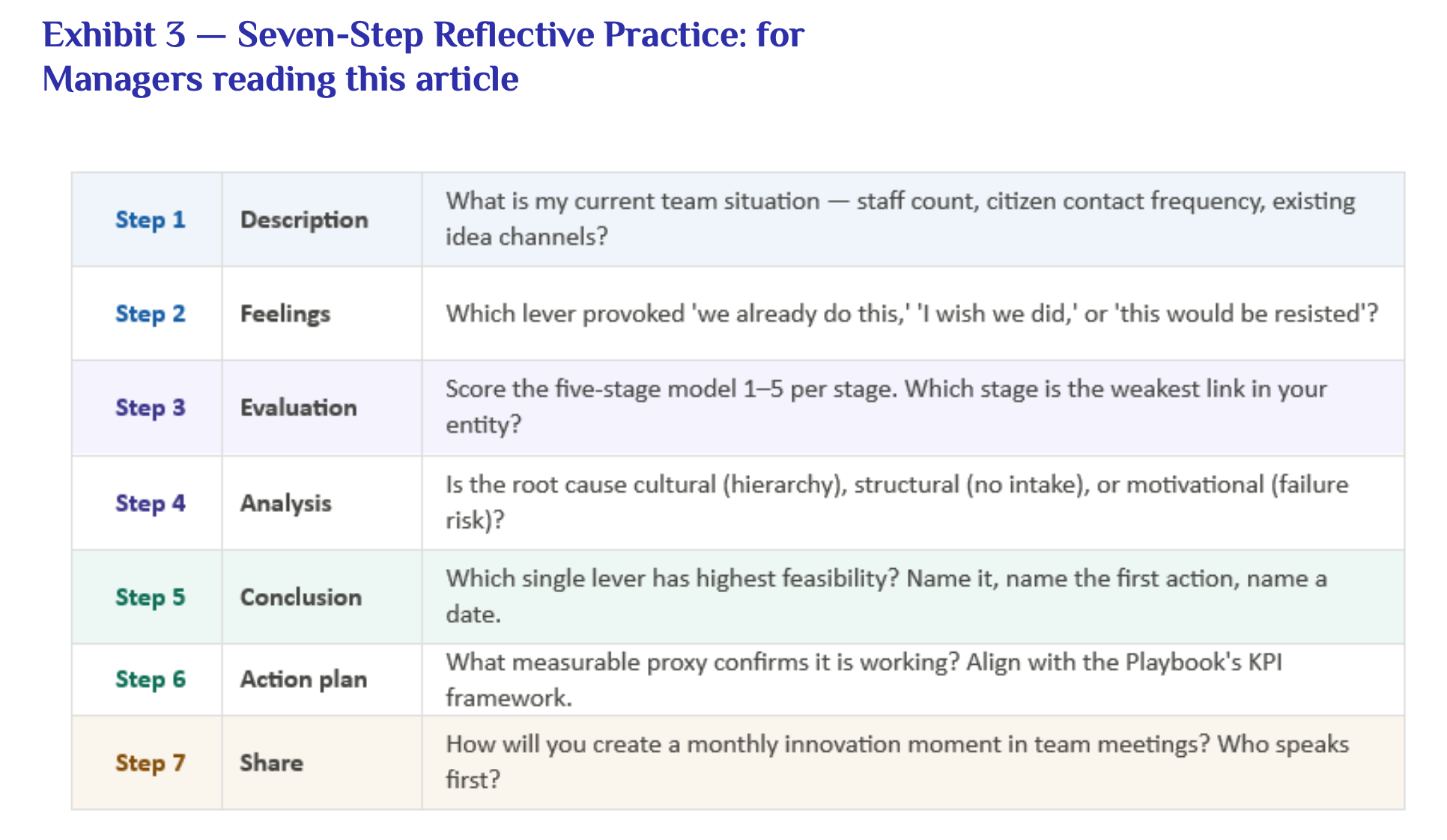
Seven-Step Reflective Practice
- Description: What is the current team situation?
- Feelings: Which lever provoked the strongest reaction?
- Evaluation: Which stage is the weakest link?
- Analysis: Is the root cause cultural, structural, or motivational?
- Conclusion: Which single lever has the highest feasibility?
- Action Plan: What measurable indicator confirms success?
- Share: How will monthly innovation moments be created?
Beyond the Framework
Insight, integrity, courage, and agility reinforce one another rather than operating independently.
When frontline insight is genuinely captured, managers gain the confidence to prioritize bold innovations and meaningful service improvements.
The Qatar Innovation Playbook is one of the most rigorous public sector innovation frameworks in the Gulf region, but its real strength depends on the extent to which frontline civil servants become active contributors to innovation.
Essential Questions for Organizations
- How are we currently capturing the observations that frontline officers make every day?
- What signals are we sending about the relationship between idea submission and professional risk?
- How many sprint cycles included frontline participation beyond interviews?
- What would happen if we reduced the time between frontline observation and tested service improvement by half?
References
- Ritter, R. & Ruggero, E. (2017). Leadership in innovation needs innovation in leadership.
- Civil Service and Government Development Bureau (2024). The Innovation Playbook.
- Partnership for Public Service & BCG (2025).
- Office for National Statistics, UK (2024).
- Nesta. How to motivate your staff to innovate.
- Gibbs, G. (1988). Learning by Doing.
- Schon, D. A. (1983). The Reflective Practitioner.